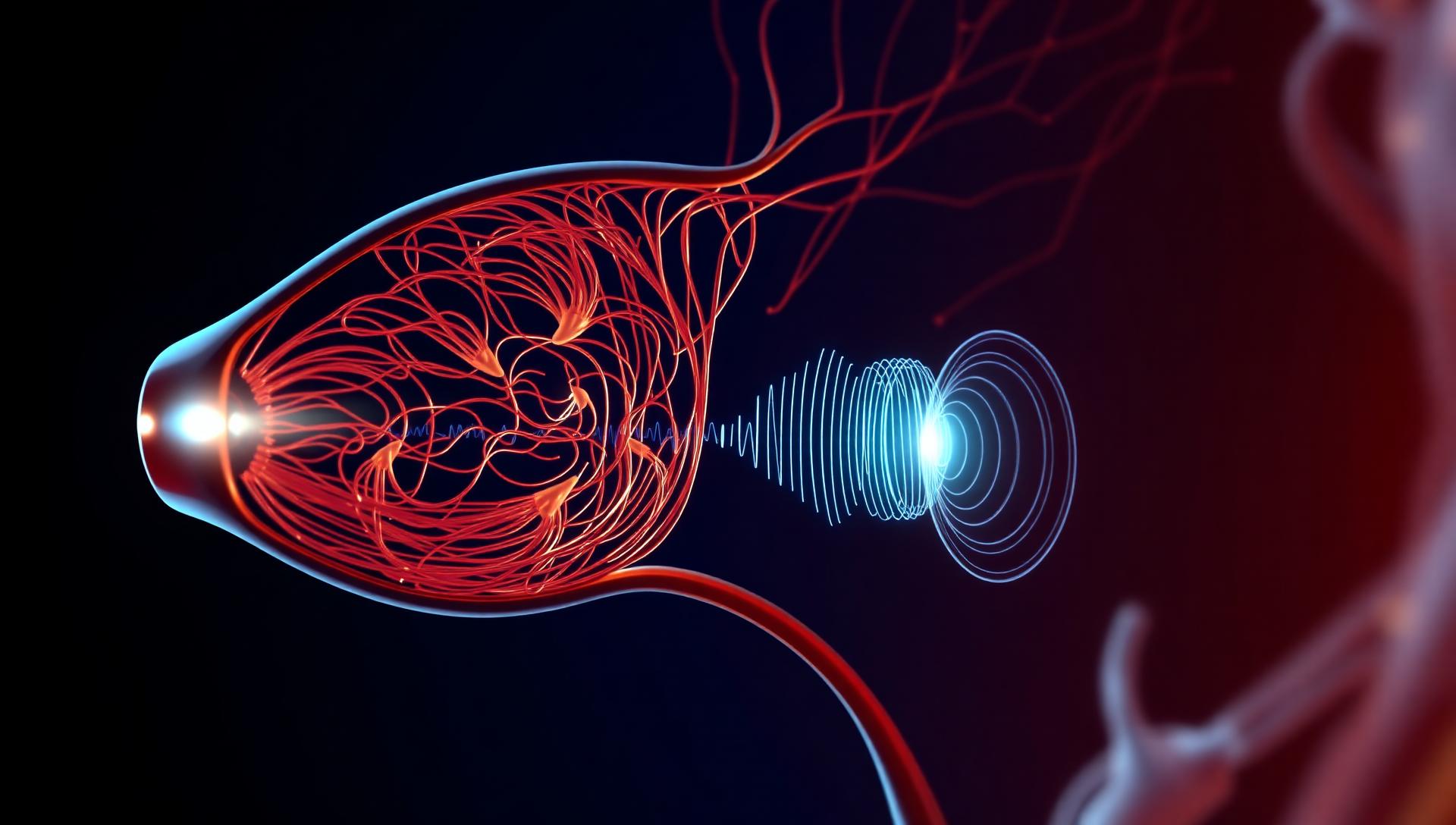
The Neuroscience of Sound
How the auditory brain converts pressure waves into perception, emotion, and meaning - from cochlea to cortex.
From pressure wave to perception
Sound begins as a pressure wave in air. That wave travels down the ear canal, moves the eardrum, and is amplified through the three smallest bones in the body - the malleus, incus, and stapes - into the fluid-filled cochlea. Inside the cochlea, roughly 15,000 specialized hair cells convert mechanical motion into electrical signals that travel up the auditory nerve. Different regions of the cochlea respond to different frequencies, giving the auditory system its tonotopic organization from the very first step (National Institute on Deafness and Other Communication Disorders, NIDCD).
From the auditory nerve, signals move through the brainstem (cochlear nuclei, superior olivary complex, inferior colliculus) and the medial geniculate nucleus of the thalamus before reaching primary auditory cortex in the temporal lobe. The whole journey takes only tens of milliseconds - faster than vision.
A distributed network, not a single spot
Beyond primary auditory cortex, sound engages a broad network. The superior temporal gyrus extracts pitch and spectral features. The planum temporale supports higher-order auditory analysis and speech. The insula and amygdala tag sounds with emotional and visceral significance. The motor and premotor cortex, along with the cerebellum and basal ganglia, help the body align to rhythm. The prefrontal cortex and reward system - including the nucleus accumbens and ventral tegmental area - contribute to attention, evaluation, and pleasure (Zatorre & Salimpoor, 2013).
The brain as a prediction machine
Modern auditory neuroscience emphasizes that the brain constantly predicts incoming sound. When a predicted event does not arrive - or when it arrives differently than expected - the brain produces characteristic error signals such as the mismatch negativity (MMN), an EEG response first described by Naatanen and colleagues (Naatanen et al., 2007). Predictive coding frameworks argue that perception itself is an active inference process, not a passive recording (Friston, 2010, Nature Reviews Neuroscience).
This is one reason music can feel so powerful: composers and listeners are engaged in a continuous game of expectation, fulfillment, and surprise (Huron, 2006).
Plasticity and lifelong change
Long-term musical training is associated with structural changes in auditory cortex, motor cortex, corpus callosum, and cerebellum, and with functional changes in how sounds are represented (Herholz & Zatorre, Neuron, 2012). Effects are strongest for training that begins in childhood but continue to be observed in adults.
Aging brings gradual changes to hearing and central auditory processing. The National Institute on Aging notes that untreated hearing loss in older adults is associated with cognitive decline and social isolation, and that addressing hearing loss is a modifiable factor in brain-health strategies (NIA; Livingston et al., Lancet Commission on dementia prevention, 2020, 2024).
Frequently asked questions
- How fast does the brain react to sound?
- Auditory information reaches the brainstem within roughly 10 milliseconds of sound entering the ear, and reaches primary auditory cortex within about 20 to 50 milliseconds. Hearing is the fastest of the human senses.
- Which brain regions process sound?
- Sound processing spans the cochlea, brainstem, thalamus, primary and secondary auditory cortex in the temporal lobe, and downstream networks in the limbic system, prefrontal cortex, and motor system.
- Can the brain change in response to sound?
- Yes. Musicians show measurable structural and functional differences in auditory and motor regions - one of the most robust demonstrations of experience-dependent neuroplasticity in the adult brain (Herholz & Zatorre, 2012).
- Is silence processed by the brain?
- Yes. Unexpected silence can activate auditory cortex in a way similar to sound, because the auditory system continuously predicts what should come next.
References & further reading
- Salimpoor, V. N., Benovoy, M., Larcher, K., Dagher, A., & Zatorre, R. J. (2011). Anatomically distinct dopamine release during anticipation and experience of peak emotion to music. Nature Neuroscience, 14(2), 257-262 DOI: 10.1038/nn.2726
- Zatorre, R. J., & Salimpoor, V. N. (2013). From perception to pleasure: Music and its neural substrates. PNAS, 110(Suppl 2), 10430-10437 DOI: 10.1073/pnas.1301228110
- Herholz, S. C., & Zatorre, R. J. (2012). Musical training as a framework for brain plasticity: Behavior, function, and structure. Neuron, 76(3), 486-502 DOI: 10.1016/j.neuron.2012.10.011
- Naatanen, R., Paavilainen, P., Rinne, T., & Alho, K. (2007). The mismatch negativity (MMN) in basic research of central auditory processing: A review. Clinical Neurophysiology, 118(12), 2544-2590 DOI: 10.1016/j.clinph.2007.04.026
- Friston, K. (2010). The free-energy principle: A unified brain theory?. Nature Reviews Neuroscience, 11(2), 127-138 DOI: 10.1038/nrn2787
- Livingston, G., Huntley, J., Sommerlad, A., Ames, D., Ballard, C., et al. (2020). Dementia prevention, intervention, and care: 2020 report of the Lancet Commission. The Lancet, 396(10248), 413-446 DOI: 10.1016/S0140-6736(20)30367-6
- National Institute on Deafness and Other Communication Disorders (2022). How Do We Hear?. NIH Source
Related articles
This article is an educational summary of publicly available research and is not medical advice. It does not diagnose, treat, or cure any medical or psychiatric condition. Where evidence is emerging or mixed, we say so. Consult a qualified professional for personal guidance.